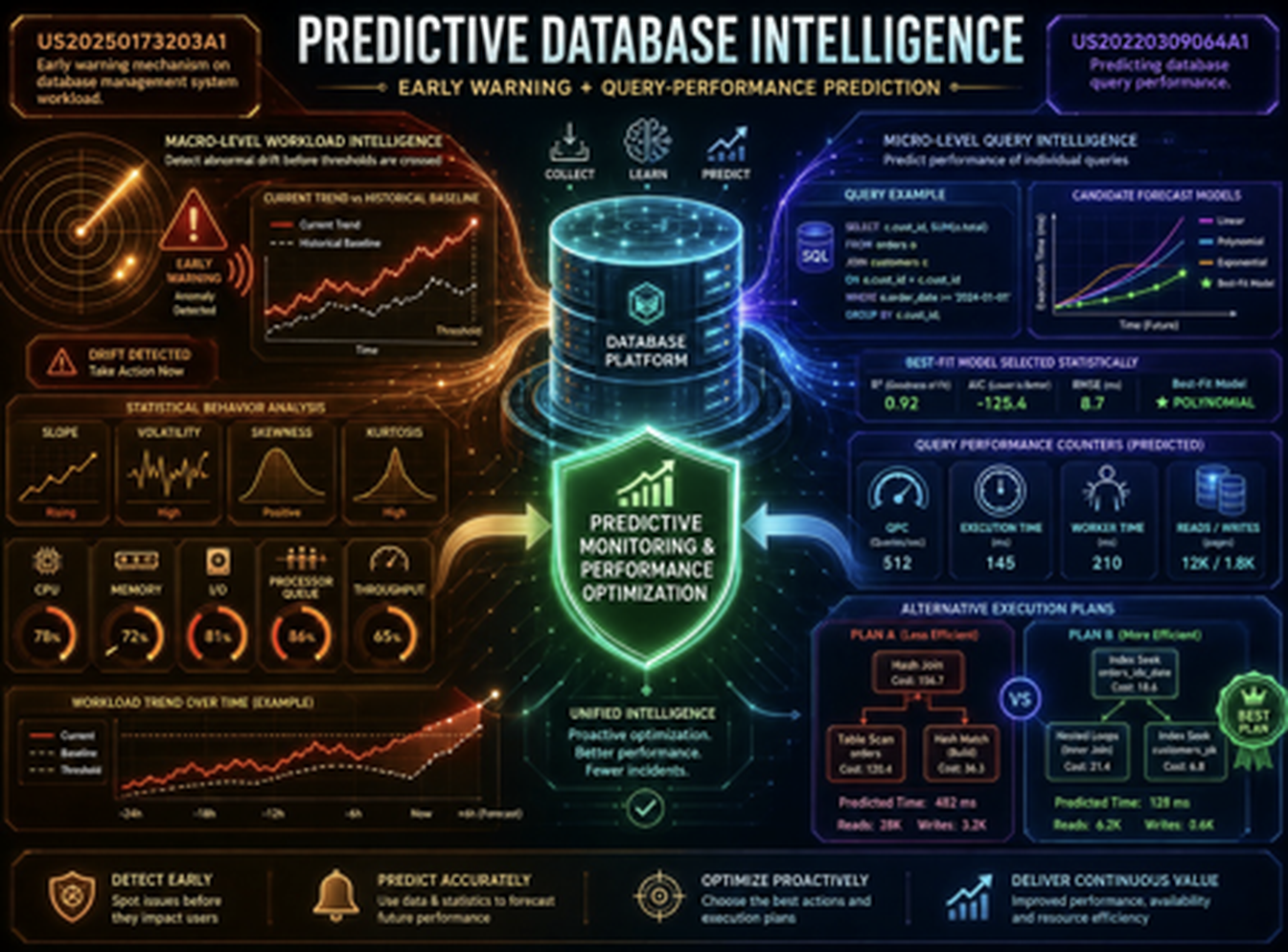
SQL Governor's patented software methodology advances database monitoring from reactive threshold alerts to predictive performance optimization by analyzing statistical changes in system workload and query performance. This dual-layer approach enables earlier detection of potential issues and more focused investigation on problematic SQL workloads, supporting proactive database management.
Why threshold monitoring is no longer enough
Traditional monitoring triggers alerts only when metrics exceed fixed limits. That sounds reasonable, but it misses gradual yet significant workload changes that predictive monitoring can detect by analyzing statistical deviations from historical trends. A slowly rising CPU slope or increasing I/O volatility can signal trouble long before any static threshold is breached.
System-level early warning
The first patented software methodology collects performance counters such as CPU, memory, and I/O and derives statistical components — slope, volatility, skewness, and kurtosis — to identify emerging workload abnormalities before thresholds are crossed. Instead of waiting for a red line to be hit, the system watches how metrics evolve over time.
Multi-dimensional warning generation
Early warnings integrate multiple statistical indicators across various performance counters, combining evidence to classify severity levels and improve detection sensitivity using machine learning. The result is fewer false positives and a clearer picture of which parts of the platform are drifting from their normal behavior.
Query-level performance prediction
The second patented software methodology predicts future query performance by considering changes in data size, distribution, concurrency, indexing, and resource contention. This makes it possible to identify SQL workloads that are likely to degrade even when the SQL itself remains unchanged — a common scenario as data volumes grow.
Two layers, one proactive workflow
The system-level workload intelligence detects statistical changes in DBMS behavior, while the query-level intelligence pinpoints specific database operations at risk. Together they enable early warning, workload prioritization, and preventive action before end users notice any slowdown.
What this means in practice
Predictive monitoring can detect abnormal trends — such as an increasing CPU slope combined with rising I/O volatility — before thresholds are crossed. DBAs are guided to investigate the specific SQL workloads behind the trend and optimize queries or configurations proactively, rather than reacting to an incident after the fact.
Technical and operational benefits
- Earlier detection of emerging performance risks
- Reduced reliance on static thresholds
- Adaptation to environment-specific baselines
- Improved DBA prioritization
- Enablement of preventive optimization
- A foundation for automated resource management
From observability to optimization
These technologies enhance database observability step by step: from basic measurement and alerting, through trend analysis and prediction, to proactive optimization. The goal is to detect risks early and focus attention on the workload areas that actually need it.
Read the technical whitepaper
A deeper dive into the methods and architecture behind SQL Governor's new US patent grants.

Jani K. Savolainen
Founder & CTO, SQL Governor